
Fire-retardant greenery for homes & businesses
Fire performance starts with the foliage.
IFR plants, trees, flowers and garlands bring greenery and built-in fire resistance to homes, shared residential spaces and commercial interiors.
Learn why people choose IFR, where it may be required, and which documentation applies to your item.
What does IFR mean?
IFR stands for inherently fire-retardant. In our documented polyester and polyethylene foliage, the fire-retardant additive is incorporated into the material during manufacturing. It is part of the foliage material, rather than a coating sprayed onto the finished plant.
Built-in IFR
The additive is part of the documented foliage material. It will not wash away, and there is no topical fire-retardant coating to renew. The foliage keeps its intended finish without an oily treatment residue.
Topical treatment
A spray or dip is applied after manufacturing. Cleaning, care and reapplication requirements depend on the treatment used. Applying and maintaining that treatment becomes part of caring for the display.
IFR does not mean fireproof or noncombustible: the material can still burn, melt or produce smoke. The reports below describe the performance of the tested foliage groups.
Why choose IFR—and where is it needed?
The purpose of IFR is to help limit sustained flaming and flame spread in the foliage. Some projects require documented performance; at home, you may want this added fire resistance even when no certificate is requested.
- Commercial and public spaces: fire-performance requirements commonly arise in hotels, restaurants, event venues, retail displays, offices, schools and healthcare settings. Check the building’s requirements before selecting foliage.
- Apartment and condo common areas: lobbies, lounges and other shared spaces may have building-management or fire-code requirements distinct from those inside a private residence.
- Houses, condos and apartments: IFR is also an option for everyday home décor. You can choose it for its fire-retardant properties without having a commercial project or needing paperwork.
A requirement may specify a fire-test result, rather than IFR by name. The accepted report depends on local rules, the material and how the display is installed. A foliage report does not automatically approve a complete tree, wall or room.
At home or at work, keep greenery away from flames and heat sources, and keep exits clear. Built-in fire resistance does not replace safe placement.
A look at two foliage samples
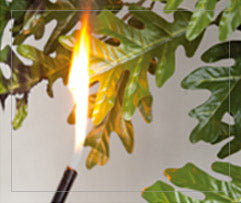
These photographs illustrate two sample demonstrations after exposure to a flame.
IFR sample
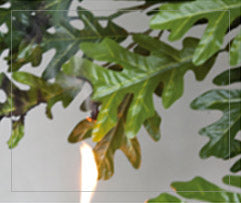
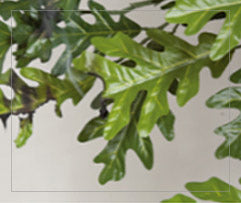
Non-IFR sample
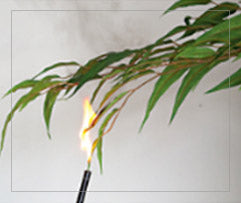
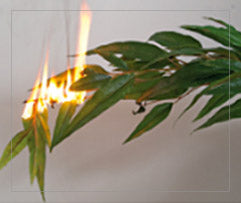
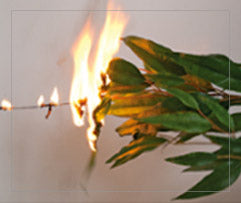
The photographs show different sample types. They illustrate the demonstrations shown; the applicable laboratory report establishes the documented test results for each foliage material group.
Which documentation applies to your item?
Check the product title first. Items titled “IFR PVC” belong to a separate group without a material-specific fire-test report. For other IFR items, use the beginning of the product SKU to identify the documented foliage group.
Polyester foliage
SKU prefixes: GR, PR, PUR, WRASTM E84-16 measures surface-burning characteristics, reporting flame spread and smoke development.
Flame Spread Index: 0
Smoke Developed Index: 130
These results fall within the Class A limits stated in the report.
Polyethylene foliage
SKU prefixes: AR, AURNFPA 701, Method 1 evaluates flame propagation in the tested material. The laboratory report concludes that the tested polyethylene foliage material passed.
California registration
Documented polyester and polyethylene groupsThese documented groups have current California State Fire Marshal Fabric Registration. The registration states that the registered foliage meets the minimum flame-resistance requirements for products identified in Section 13115.
What is covered: Reports are shared across the applicable foliage material groups, rather than issued separately for every SKU. Natural wood trunks are outside the foliage documentation. A report for one material group does not establish the results for another.
Used in professional spaces
The documented IFR foliage range has a commercial history reaching back to the early 1980s. Applications include offices, airports, schools and universities, medical facilities, shopping centers and cruise ships.
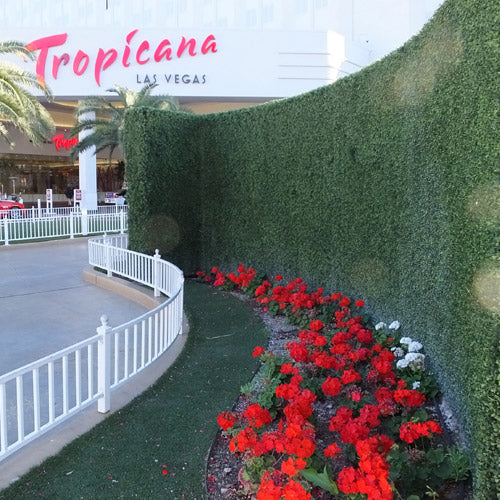
These installation examples show two different approaches: tall trees that give a large interior a focal point, and foliage walls that bring greenery into a corridor. Both use planting as part of the design of a space, beyond a single decorative accent.
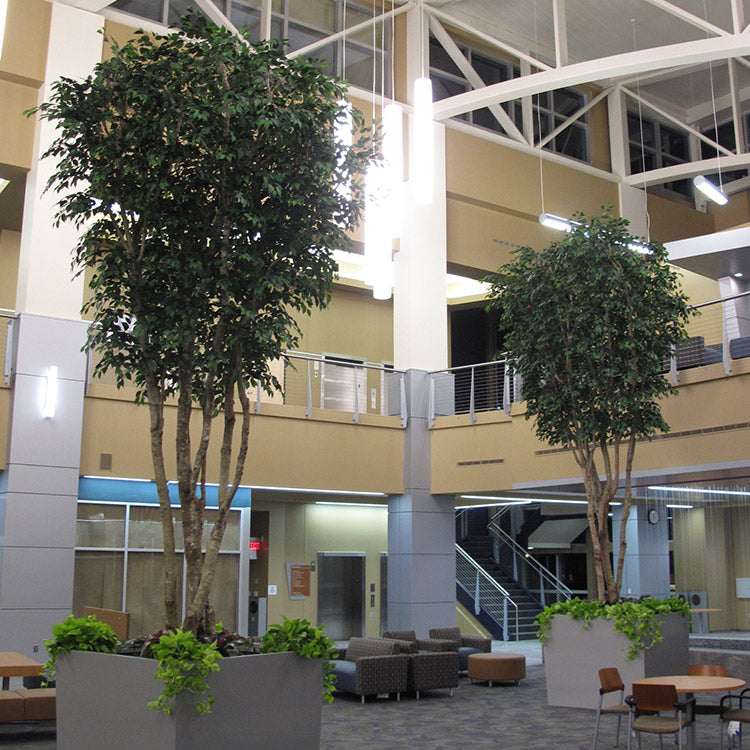
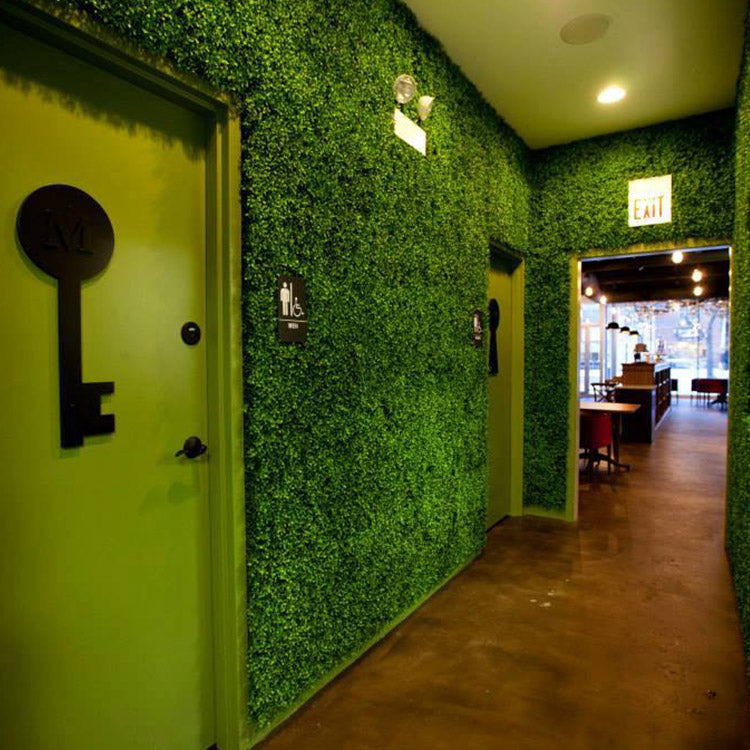
For your own project, start with the effect you want—height, coverage or a softer background—then choose the appropriate IFR item and documentation.
Using IFR greenery outdoors
Outdoor fire-performance requirements can apply to homes as well as businesses. An HOA may require fire-rated artificial foliage around homes in a fire-prone area; a commercial property may have similar project requirements.
Choose an item with “IFR” plus “UV-Resistant” or “UV-Proof” in the title, suited to its actual exposure. UV-Resistant + IFR offers limited UV protection for gentler sun; UV-Proof + IFR combines commercial-grade outdoor foliage with built-in fire resistance. IFR alone does not establish outdoor suitability.
Confirm the specific requirement with the HOA or project reviewer. IFR foliage is not noncombustible or a guarantee of wildfire protection, and it does not automatically satisfy wildfire landscaping rules.
Need documents for your project?
After purchase, contact us with your order number and product SKU. We will match the item to the available material-group documents. If your fire marshal or project reviewer has requested a particular report, include that information.
Request available documentsCommon questions
Does IFR mean my project automatically meets its fire code?
The IFR designation describes the foliage material. Project requirements depend on the applicable code and how the greenery is used. If documentation is requested, ask your fire marshal or project reviewer which report they need.
Do all IFR products pass the same fire test?
Documentation differs by material. Our documented polyester group uses the ASTM E84 report, while our documented polyethylene group uses the NFPA 701 Method 1 report. These tests measure different things and their reports are not interchangeable. IFR PVC is a separate group without a material-specific report.
What does “Class A” mean here?
It refers to the surface-burning classification limits stated in the ASTM E84 report. The recorded flame spread and smoke developed indices fall within those limits. Class A is not a statement that a material cannot burn, melt or produce smoke.
What if my item is titled “IFR PVC”?
It is manufacturer-designated IFR polyvinyl chloride foliage. A material-specific fire-test report is not available for this group. If your project requires documentation, confirm whether an item without that report can be accepted before buying.
Will the IFR treatment wash off?
In the documented polyester and polyethylene groups, the additive is built into the foliage material and will not wash away. Follow the individual product’s care instructions; not every cleaning product or method is suitable for every item.