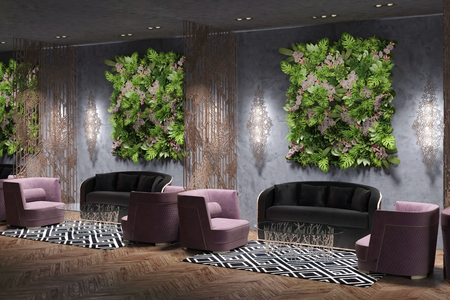
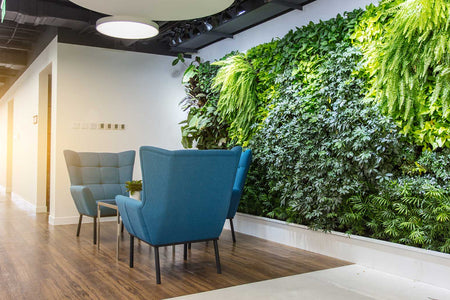
If you're reading this, you're probably staring at a floor plan, a property list, or a punch list, and you need a lot of plants. Maybe you're refreshing the common areas of a hotel, opening the next four locations of a restaurant concept, dressing a corporate campus, or keeping a standing TV set looking sharp, shoot after shoot.
Whatever the project, ordering at this scale is its own discipline. Let's talk about how to order artificial plants in bulk in a way that won't have you chasing freight quotes from six suppliers and fielding emails about why the planters in Location 3 don't match the planters in Location 7.
Who This Guide Is For
This guide is for the person who has to outfit an entire environment with bulk artificial plants and who is accountable when it doesn't come together. That's typically a facilities manager, an interior designer working a hospitality or commercial brief, a property manager, a procurement lead, an event production coordinator, or a set decorator. Different titles, same problem: you need artificial plants, you need them to look right together, and you don't have time to source them piecemeal.
Artificial Plants in Bulk: Estimating Quantities
The fastest way to get to a defensible count is to start thinking in zones. Walk the space (or the floor plan) and identify where greenery works: anchoring an entrance, softening a corner, breaking up a long sightline, or dressing a tabletop. How many of each zone do you have? Then choose a "tier" of plants for each zone type and multiply.
Hotel Lobbies
Consider 2–4 statement pieces, typically artificial trees (think palm trees) flanking entrances and anchoring seating clusters, plus 6–12 mid-height silk plants at concierge stations, end tables, and elevator banks, and a rotating set of silk flowers for reception and lounge surfaces. Multiply by the number of common-area zones (lobby, bar, breakfast room, business center, and club lounge), and you have a per-property number you can defend.
Office Spaces
A large open-plan office floor is more forgiving but also easier to under-decorate. A reasonable starting point is one silk tree or large plant per 800–1,200 square feet of open space, plus desk-height greenery at every reception point, huddle room, and break area. Long blank walls and partitions are where a lot of buyers run out of ideas. That's where decorative greenery and artificial grass mats come in handy, since they cover vertical real estate without you having to source dozens of individual stems.
Restaurants
The dining room carries a lot of your brand identity, so it's worth thinking in three layers: entry impact (an artificial tree or a pair of topiaries), tabletop consistency (a small silk flower arrangement per four-top, or a shared piece per banquette section), and ambient greenery along banquettes, partitions, and the host stand. For a restaurant group, lock the per-restaurant SKU list once, then multiply it by the location count. That's the whole game when ordering faux plants in large quantities for a multi-unit rollout.
Retail Chains
Retail stores need less greenery than people expect: two to four medium plants per store and a single statement tree, scaled up for flagships.
Standing Movie Sets
Standing television and film sets are dictated by the script and the camera, but be sure to order spares. Hero pieces take a beating under lights and constant re-blocking, and a backup tree on day three is less expensive than a delayed shoot.
Keeping the Look Consistent Across Multiple Locations
This is where most multi-location projects quietly fall apart. Buying for one room is a taste exercise. Buying for twenty is a system, and the system has to survive the next person who picks up your spec sheet.
Matching Planters
The plants themselves are not the biggest problem; it's the planters. Mismatched containers are the single most common reason a rollout looks "off," even when every plant is beautiful. Pick your container family early from a single source and write it into the spec the same way you'd write paint codes or upholstery SKUs. Look for vases and planters of similar material: fiberglass, ceramic, cement, glass, basket, bamboo, or metallics. It's much easier to specify "matte black fiberglass at the 18-inch and 24-inch sizes, every location" than to reverse-engineer matching pots later.
Coordinated Colors
The other piece is palette discipline. Greenery reads as neutral, but it's not. There's a real difference between a warm olive-and-sage palette and a cooler deep-emerald one, and mixing them looks accidental. Pick a lane. For silk florals, choose two or three signature blooms and rotate them seasonally, instead of inventing a new look every quarter. Affordable, simpler, and uber photogenic.
Mind the Heights
Most commercial projects work cleanly with three tiers: statement (6–8 ft), mid (3–5 ft), and tabletop (under 2 ft). Once those tiers are set, you're just choosing within each one. One thing worth knowing as you spec: because larger plants and trees are handmade, taller pieces can vary by a few inches between units, but pre-arranged floral pieces are more exact. For multi-location work, that's an argument for ordering all units of a given SKU at the same time rather than topping up months later.
Where IFR Matters
Inherently fire-retardant (IFR) plants and flowers are a smart choice for commercial settings such as hotel lobbies, restaurants, theaters, schools, healthcare facilities, casinos and convention centers. When fire documentation is requested, we can provide the applicable material-level report for documented foliage groups after purchase.
Look for fire-retardant artificial plants with documentation appropriate to the foliage material. Our documented polyester foliage group has an ASTM E84 report with Class A results, while the NFPA 701 Method 1 report for our documented polyethylene foliage group concludes that the tested material passed. Both documented groups also have current California State Fire Marshal registration. The fire-retardant additive is incorporated into these materials during manufacturing, so it will not wash off or leave the oily film associated with some topical finishes.
For projects requesting fire-retardant greenery, choose an IFR style and use the product title and SKU prefix to identify the applicable documentation. If paperwork is requested, ask which material-group laboratory report or California registration is needed.
A note on outdoor zones: most artificial plants will fade in direct sunlight (including indoor sunlight through a window) unless they're labeled UV-Resistant or UV-Proof. UV-Proof products are guaranteed against fading for at least five years (three in Arizona, Texas, and Florida); UV-Resistant products delay fading but carry no guarantee. For exterior installs, that distinction matters more than the price difference, so spec accordingly.
Why a Deep Catalog Saves You More Than Money
The real cost of a large project is the coordination. Every extra supplier means another freight schedule, another invoice, another opportunity for someone else's "ivory" to clash with your "cream." The biggest efficiency win when you buy artificial plants in bulk is consolidating with one supplier that has enough breadth to complete the entire job.
That's where 15,000-plus SKUs begin to matter. Statement trees for the lobby, topiaries for the entrance, mid-height greenery for the floor, tabletop florals for the dining room, garlands and wreaths for the seasonal refresh, and the planters to hold all of it: all on the same purchase order, from the same supplier, color-matched to the same standard. That's the case for bulk artificial greenery for businesses outfitting full environments, not just decorating one wall.
A few reasons why commercial buyers have landed at Silks Are Forever (SAF):
-
No minimum order quantity at the order level: SAF sells direct to the public with no wholesale gate to qualify for. (Items are sold in pack quantities, so the smallest unit is one pack, but there's no order minimum on top of that.)
-
Direct-from-importer pricing on every SKU, since SAF imports straight from manufacturers in China, Thailand, and elsewhere rather than buying through distributors.
-
Larger companies can use their own UPS or FedEx account for shipping, which is useful if you've negotiated freight rates as part of your procurement process. You enter the account number in the customer notes at checkout, get billed for shipping initially, and have it credited back when the package ships.
How To Get Started With Silks Are Forever
If you'd like to spec from the catalog yourself, the most efficient path is to start with the anchor categories, such as silk plants and artificial trees to set your statement tier, then layer in topiaries, planters, and silk flowers for the mid and tabletop tiers.
If you'd prefer to hand off a punch list or a floor plan and have someone else do the spec work, including IFR substitutions for regulated zones, get in touch. Email replies usually come back within 24 hours, weekends included.
FAQs: Artificial Plants for Commercial Interiors
Is there a minimum order quantity required to purchase artificial plants or silk flowers from Silks Are Forever?
There's no minimum order quantity on top of standard pack sizing. Items are sold in pack quantities (so the smallest purchase of any given SKU is one pack), but there's no wholesale tier you have to qualify for and no order-value minimum to clear. Direct-from-importer pricing applies across the catalog. If you'd like a quote on a specific project or a higher-volume order, reach out, and we'll put numbers together for you.
How are large or bulk orders of artificial trees and plants packaged and shipped to protect them during transit?
Whenever possible, orders ship via UPS Ground or FedEx Ground. A small number of larger items, usually full-size trees or palms, need to be crated and sent by a common carrier instead. For a multi-pallet or multi-location project, the cleanest path is to contact us before you place the order so we can confirm the right mix of carrier methods, packaging, and delivery timing for your specific job. Larger commercial buyers can also use their own UPS or FedEx account if they have negotiated rates.
If I'm outfitting multiple locations with the same look, can I reorder the same products months later and expect color and style consistency?
For most core SKUs, yes, they're stocked continuously, which is what makes phased rollouts and replenishment possible. That said, the catalog does turn over (items get discontinued and replaced as new products come in), and because plants and trees are handmade, larger pieces can vary slightly between production runs. For projects that depend on tight visual consistency across many units, the safest path is to order all units of each standardized SKU together rather than reordering later, and to flag your project with us up front so we can advise you of stock depth. Send us the details, and we'll help you plan the cadence.
Your Best Source for Artificial Plants in Bulk
From the statement trees in the lobby to the tabletop florals in the dining room, Silks Are Forever has the breadth, available material-level IFR documentation and the direct-from-importer pricing to help you furnish your commercial project with bulk artificial plants. Browse silk plants, artificial trees, palm trees, topiaries, fire-retardant plants, planters, and silk flowers or contact our team at 800-451-1598 with your floor plan or punch list, and we'll work with you to create a beautiful, cohesive space.